Mike Nelson was simply going about his day when his phone began to light up.
“Congrats on Decanter!”
At first, he wasn’t sure what had happened. After a few messages from friends and colleagues in the industry, he texted his wife, Kristen, who was in San Antonio with their daughters at a dance competition. Kristen handles much of the communication for Ab Astris and had packed the bottles and sent them to London for the Decanter World Wine Awards.
Had the results come in? Had they done well?
She checked. Ab Astris had received one Gold medal, two Silvers and several Bronzes.
Mike’s first reaction was actually a bit of disappointment. After all, Ab Astris had received eight Gold and Double Gold medals at the San Francisco Chronicle Wine Competition. One Gold, accompanied by Silvers and Bronzes, sounded modest.
Then he began to understand the weight of the moment.
Only 32 American wines had received Gold medals at Decanter that year. Four of them came from Texas. The Ab Astris 2022 Souzão had earned 96 points, placing it at the very top of the Gold range.
A Texas wine made from an obscure Portuguese grape had reached one of the highest levels at the world’s largest wine competition.
An Earlier Sign of Things to Come
Decanter was not the first time a Hill Country Souzão had caused someone outside Texas to stop and look again.
In December 2017, wine critic Elin McCoy combed through her notes on several thousand wines and selected just ten that had most surprised, impressed or moved her that year.
The company was extraordinary. The list included a 1955 Château Siran from Margaux, a $470 magnum; the 2014 Domaine de la Romanée-Conti Montrachet, priced at $6,000; and the 1917 Château Le Puy Cuvée Emilien, at $24,143—along with distinguished wines from Hermitage, Barolo, Napa and Chile.
Among those ten was a $95 bottle from the Texas Hill Country: the 2014 Bending Branch Estate Souzão.
McCoy singled it out as “my most surprising wine of the year,” describing it as a rich, polished dry red with wild, exotic flavors.
She ended with a seven-word invitation:
“I hope Texas wineries take note.”
A Bottle in Lodi
Ron Silva, owner of Silvaspoons Vineyards, had been dubbed “Lodi’s Portuguese Grape King” by wine writer Randy Caparoso for his work with Portuguese varieties in Lodi’s warm climate.
While at Bending Branch Winery, John Rivenburgh came to know Silva through winemaker Greg Stokes of Ursa Vineyards, whom John regarded as a mentor early in his winemaking career. During a visit to Lodi, Silva handed John a bottle of Souzão and made a recommendation that would begin the grape’s Texas story.
“John, you need to be growing Souzão in Texas, and you need to make some, and I’d love to sell you some fruit.”
Over dinner with Stokes, John tasted the wine and was “blown away.” He immediately called Dr. Bob Young:
“Bob, we’ve got to buy—I’d love to make some of this Souzão out of California, and I’d love to grow some of this in Texas.”
Bob and John made a Souzão at Bending Branch from Silva’s California fruit. In 2011, they planted the grape on the Bending Branch estate, just above the winery—the first planting of Souzão in Texas.
The bottle from Lodi had now become a vineyard in the Hill Country.
Built for the Hill Country
In Portugal, where it is generally known as Sousão in the Douro and Vinhão farther north, the grape has traditionally been valued less as a soloist than as a powerful member of an ensemble.
Its dark color, forceful acidity and structural intensity make it particularly useful in Port, where the relatively short fermentation and skin-contact period puts a premium on grapes that can give up color and tannin quickly.
Dry varietal bottlings, however, have historically been far less common.
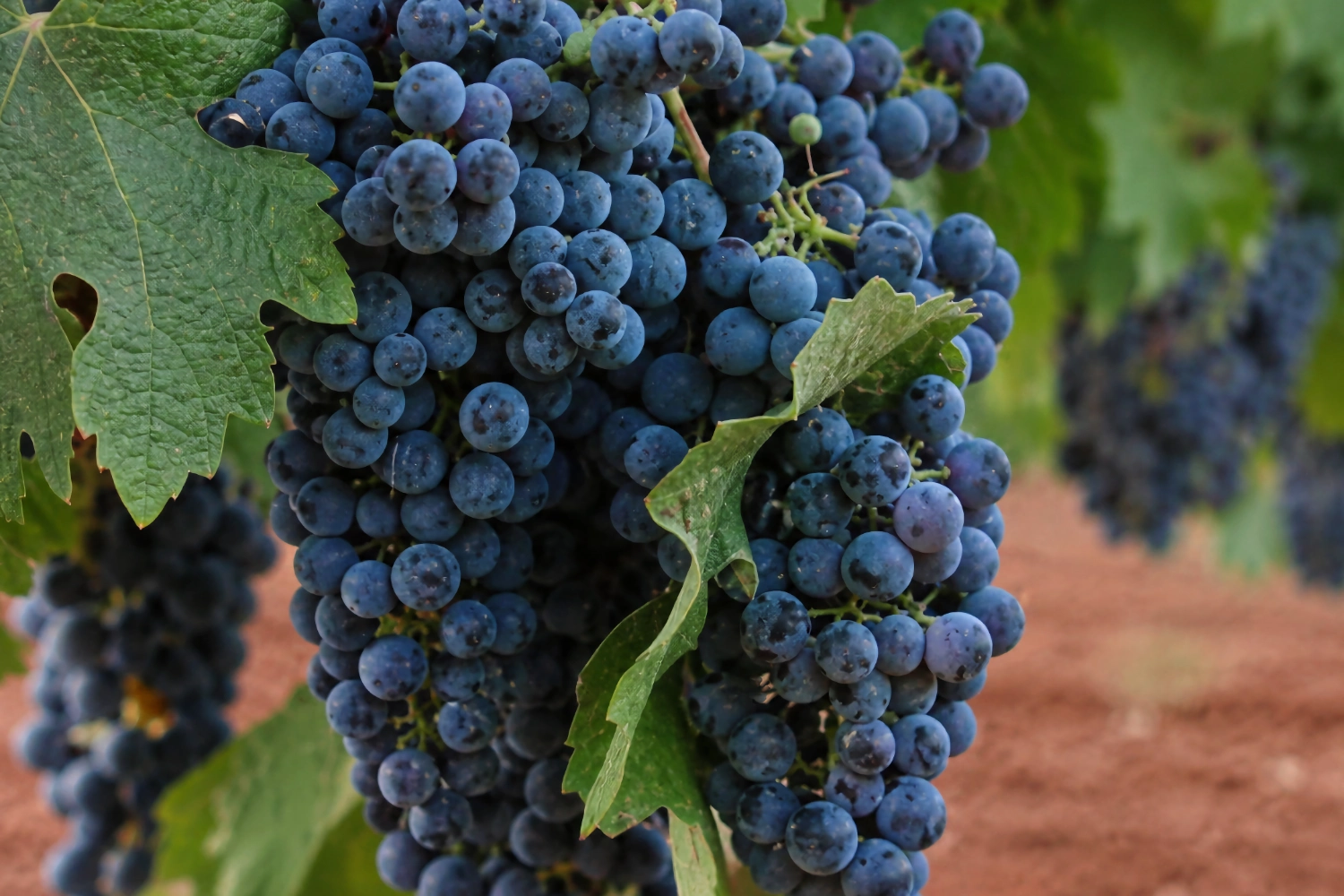
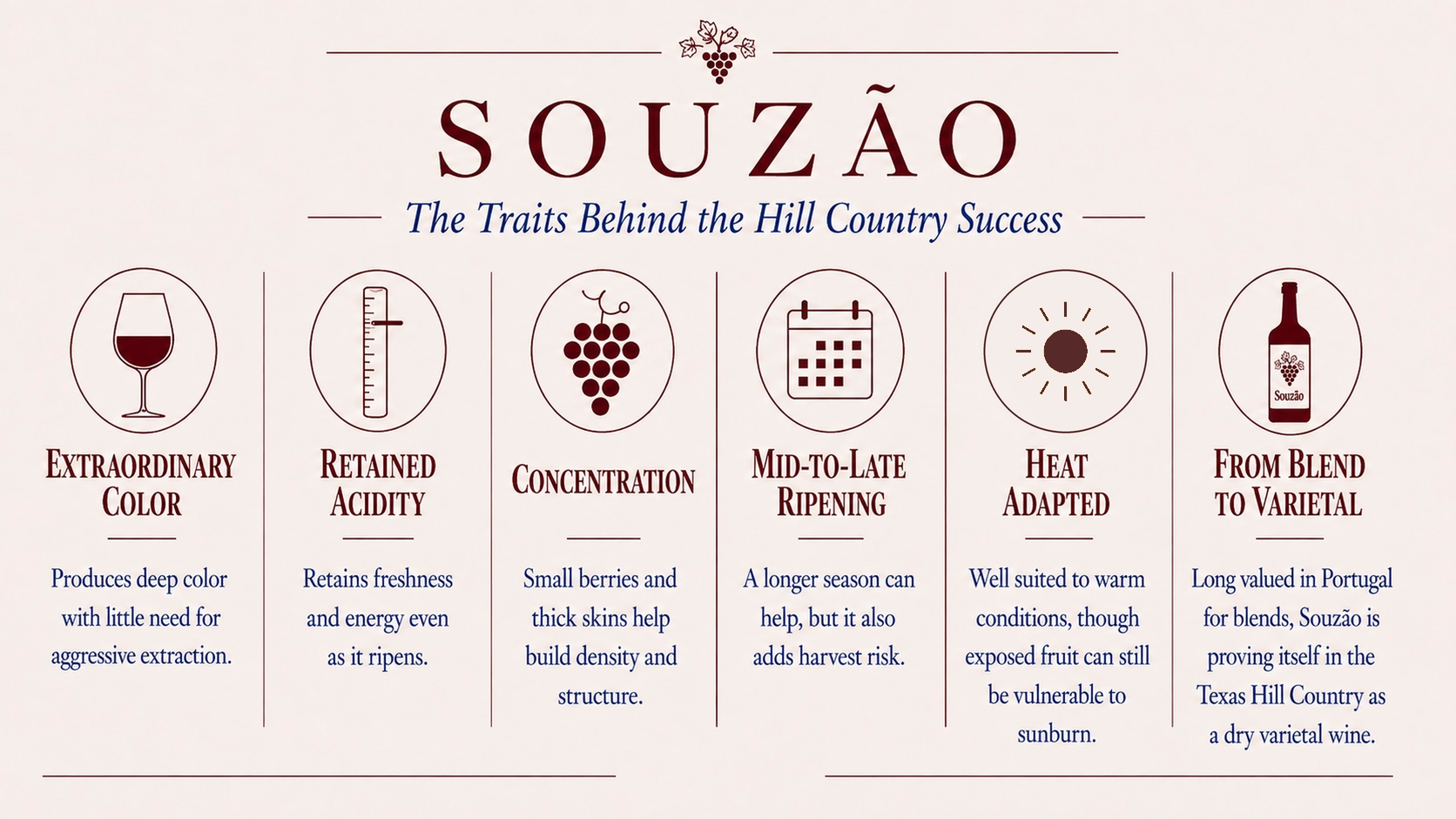
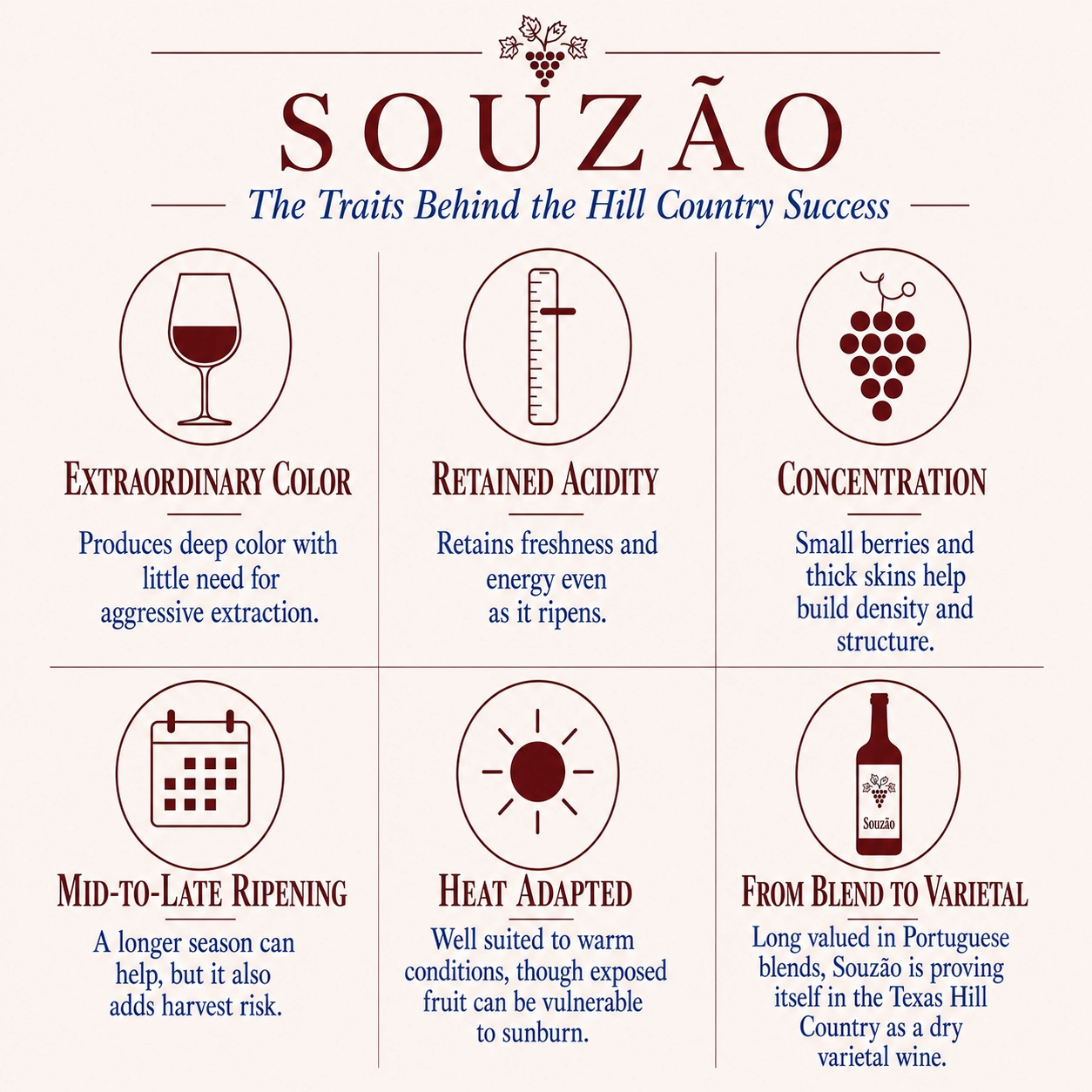
The color is something you can’t possibly miss.
On a visit to Texas Heritage Vineyard, winemaker Tyler Buddemeyer encouraged me to taste a ripe Souzão berry. When I bit into it, the juice looked almost black—startlingly dark straight from the vine.
Souzão is often described as a teinturier grape—a variety whose flesh, not just its skins, contains red pigment. Whether Souzão actually qualifies as a teinturier grape is not entirely settled, with some sources attributing much of its remarkable color to intensely pigmented skins rather than truly red flesh. Some accounts suggest that the flesh develops red color only as the berries reach full ripeness, while historical descriptions of the grape even note that red-fleshed and colorless-fleshed berries can occur on the same bunch.
What matters in the Texas Hill Country—a hot climate where grapes can reach sugar ripeness before developing deep color—is that Souzão produces extraordinary color with remarkably little effort in extraction.
Color is only part of the equation. Dr. Bob Young estimates the grape’s phenolic extraction around the 90th percentile for Texas reds, while Mike Nelson has found that Souzão holds its acidity unusually well as it ripens.
Together, those traits help explain the attraction. The grape can bring depth, freshness and structural material at the same time—qualities that are not always easy to preserve together through a Texas Hill Country summer.
Taking Root
At Bending Branch, the site was hot and well drained. The vines were trained vertically in an unusual system Dr. Young calls a “step ladder,” lifting the fruit higher from the ground.
By the 2014 harvest, the fruit was dark, concentrated and complex. That became the wine that Elin McCoy discovered.
Bending Branch kept working with the variety as plantings spread. A 2020 Estate Souzão from Lost Pirogue Vineyard later earned 94 points from Jonathan Cristaldi.
Ever the innovator, Dr. Young turned to aging with native Texas white oak for the 2022 vintage from Camledge Vineyard, formerly Lost Pirogue. James Suckling awarded the Camledge Vineyard Estate Reserve 92 points, describing a wine with balance, floral and mineral character, dark plum, cherries and blackberries.
It sold out quickly.
Bending Branch had shown that Souzão could do more in Texas than add color or structure to a blend. It could stand on its own, vintage after vintage, and attract attention far beyond the state.
The question remained: would Souzão succeed beyond the winery that introduced it?
Spreading the Word
Even before John Rivenburgh left Bending Branch, Souzão was beginning to spread beyond the estate.
Rustic Spur became the first Souzão planting outside the Bending Branch estate. Lost Pirogue followed.
Rustic Spur, on Gellerman Lane on the north side of the Pedernales River Valley, was already one of the early established vineyards in that basin. The young Souzão vines reinforced one of the lessons John had begun to learn: the variety can look weak and unpromising for several years before suddenly becoming vigorous and productive.
When John left Bending Branch in 2016, that work continued. He consulted with growers and wineries, helped establish new programs and continued recommending Souzão to people he believed had the site and ambition to handle it.
John’s own approach to Souzão leans into the grape’s rustic side. He talks about the tobacco and molasses character that can emerge from it. Because color is not something he has to fight to extract, he can favor cooler, longer fermentations without needing a more aggressive approach.
His 2020 Rivenburgh Wine Rustic Spur Vineyards Souzão earned 96 points from Jonathan Cristaldi.
Gaining Ground
John had been part of Texas Heritage’s formative years, and his recommendation led Billy and Susan Johnson to plant two acres of Souzão in 2018.
The vines initially behaved exactly as he had warned. In a May 2021 interview with Shelley Wilfong on the This Is Texas Wine podcast, Susan said Souzão “takes a few years for those vines to take off.” After several discouraging establishment years, Texas Heritage harvested its first meaningful estate crop that fall.
Tyler Buddemeyer has found the variety both distinctive and demanding. It buds late, which can offer some protection from spring freezes, but also ripens late. Its clusters are small and compact, and Tyler considers it one of the lower-yielding varieties at the estate, though production increased substantially as the young vines matured. What the fruit gives back is deep color, strong phenolics and the natural acidity Tyler values so highly.
In the winery, Tyler’s restraint is in the treatment, not in the result. He generally prefers approximately two to two and a half years in neutral oak. Because he also works in the vineyard and understands how much labor goes into producing the fruit, he prefers less influence from oak. A small portion of newer oak may add complexity, but his aim is to keep the fruit at the center of the wine.
Reviewing the 2021 Texas Heritage Estate Souzão for James Suckling, Jim Gordon called it concentrated, firm and powerful and awarded it 94 points—the highest Suckling rating found for a Texas Souzão.
Jonathan Cristaldi went higher: 96.
The 2021 estate wine added to a pattern that was beginning to emerge across the Hill Country. It showed that Souzão could succeed in another vineyard, under another winemaker, with another philosophy.
At Texas Heritage, early production has been limited—and the varietal wine so successful—that Tyler has rarely had enough to spare for a blend.
Into New Territory
When Mike and Kristen Nelson were deciding what to plant at Ab Astris, they were looking broadly for substantial red varieties they believed could perform well at the Texas Hill Country estate. Touriga Nacional was among the alternatives they considered. They had already tasted the California Souzão from Silvaspoons and were struck by its color.
John’s recommendation helped settle the question.
The Nelsons planted two acres. What followed was not easy.
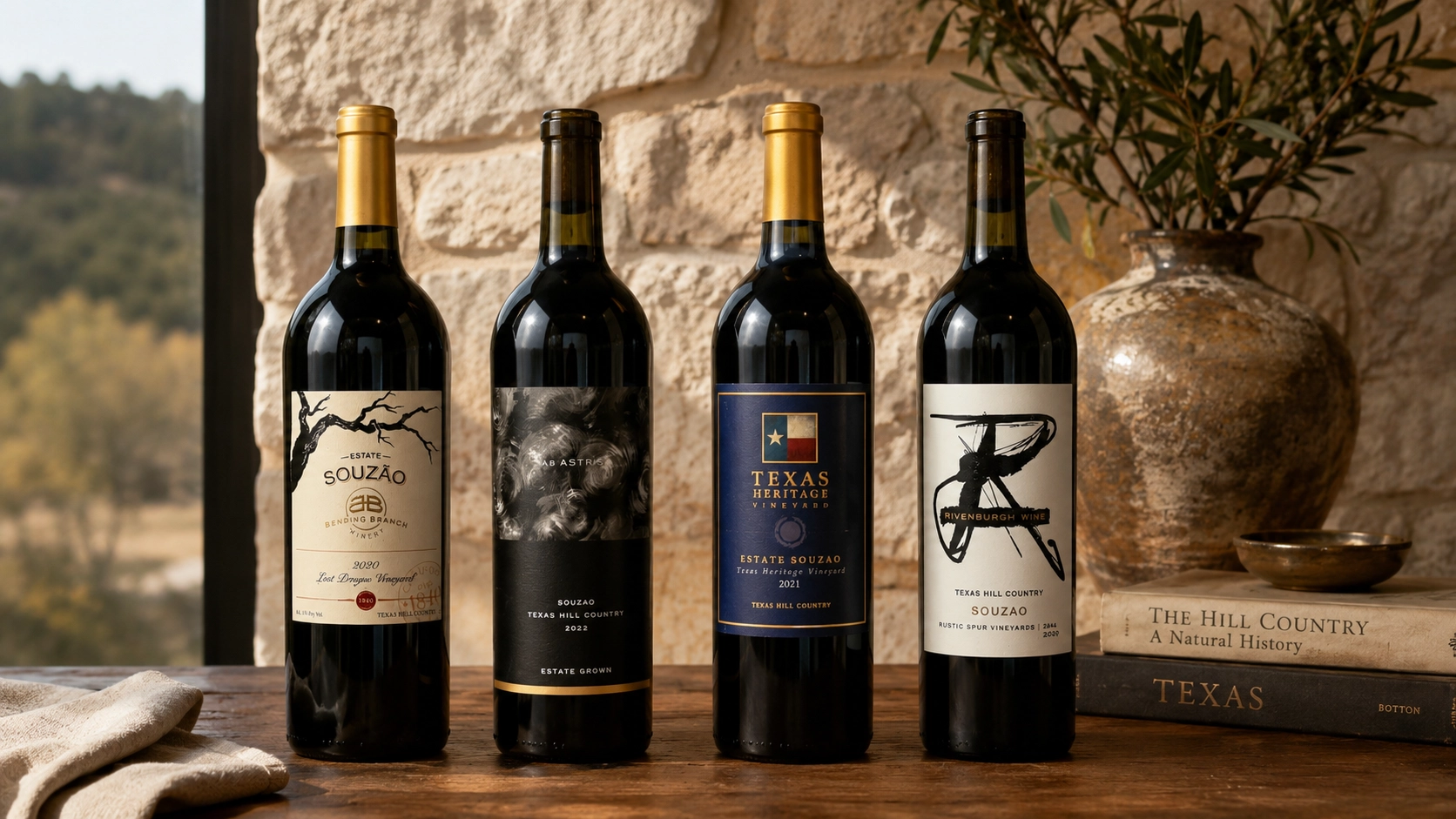
The low yields are especially apparent at Ab Astris, where Souzão typically produces only around 1.5 to 1.75 tons per acre. And because the fruit remains on the vine so late, raisining and birds become increasing concerns as harvest approaches.
The same characteristics that make it difficult also make it valuable. The small berries and thick, dark skins bring concentration. The acidity remains. The resulting wine has enough mass to handle an oak program that would overwhelm a lighter grape.
At Ab Astris, Mike typically ages Souzão for around 30 months, using approximately 30 to 40 percent new American oak with the remainder neutral.
The 2020 Souzão ripened slowly to approximately 25.75 Brix. It became a broad, lush wine approaching 15 percent alcohol. James Suckling awarded it 92 points. It earned Gold at the San Francisco Chronicle Wine Competition and was selected for the Texas Vintners Cup.
To Mike, that wine established the standard.
The 2022 did not initially seem to match it.
It struck Mike as less supple and less obviously lush. At 13.9 percent alcohol, it was unusually restrained for an Ab Astris red. Mike liked the wine, but he assumed the next vintage might be better.
James Suckling again awarded it 92 points.
Then it went to London.
The Decanter judges saw something more: “Intoxicating blackberry and plum fruit with hints of lavender on the nose. Densely packed with oak tannins, mouth-coating texture and fascinating length. A beautiful, complete wine.”
They awarded it 96 points and Gold.
Competing at the Top
James Suckling and Jonathan Cristaldi taste and evaluate wines from across the world. Their ratings had already placed Texas Hill Country Souzão in international company.
Their scores are important not only because they are high, but because they keep recurring:
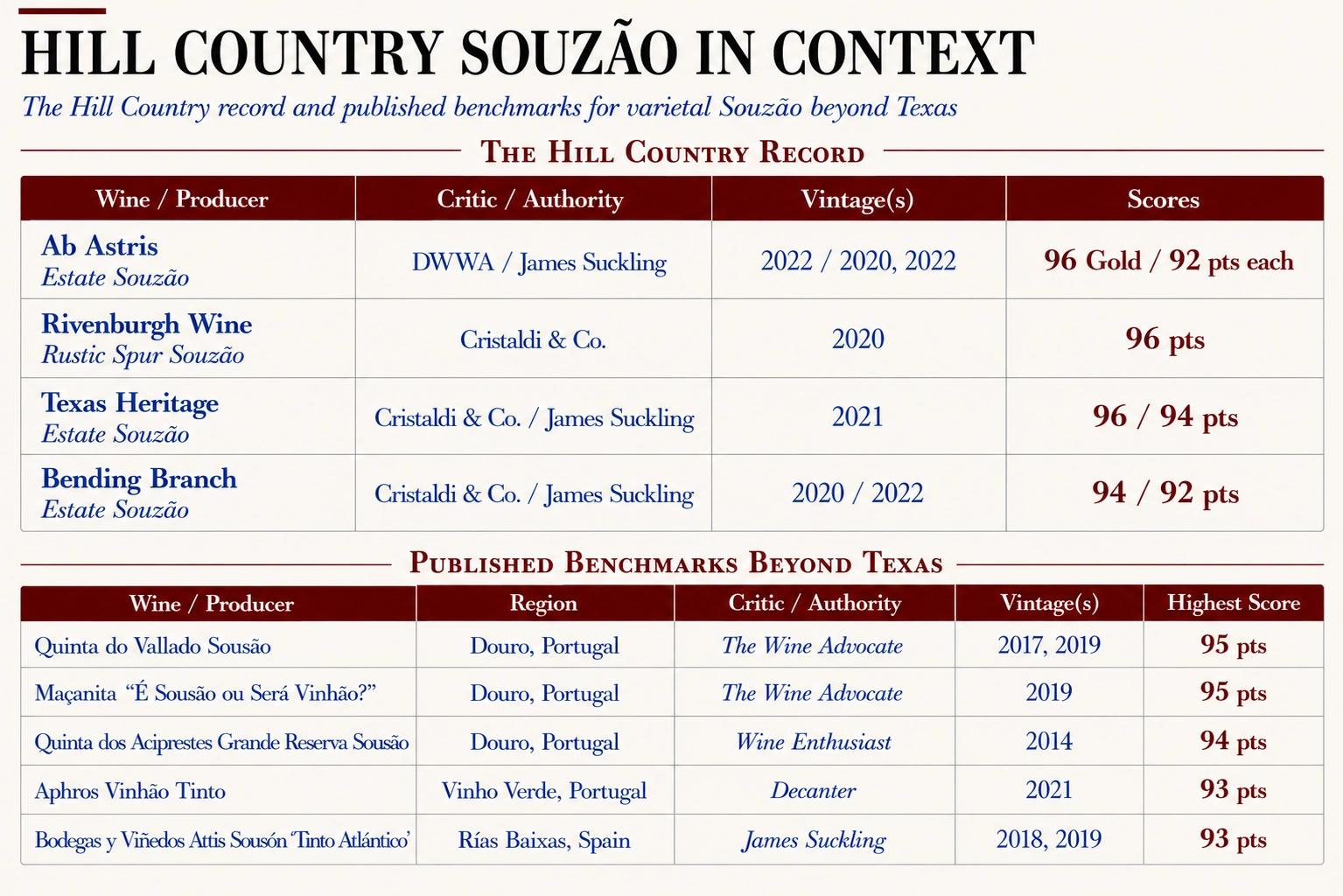
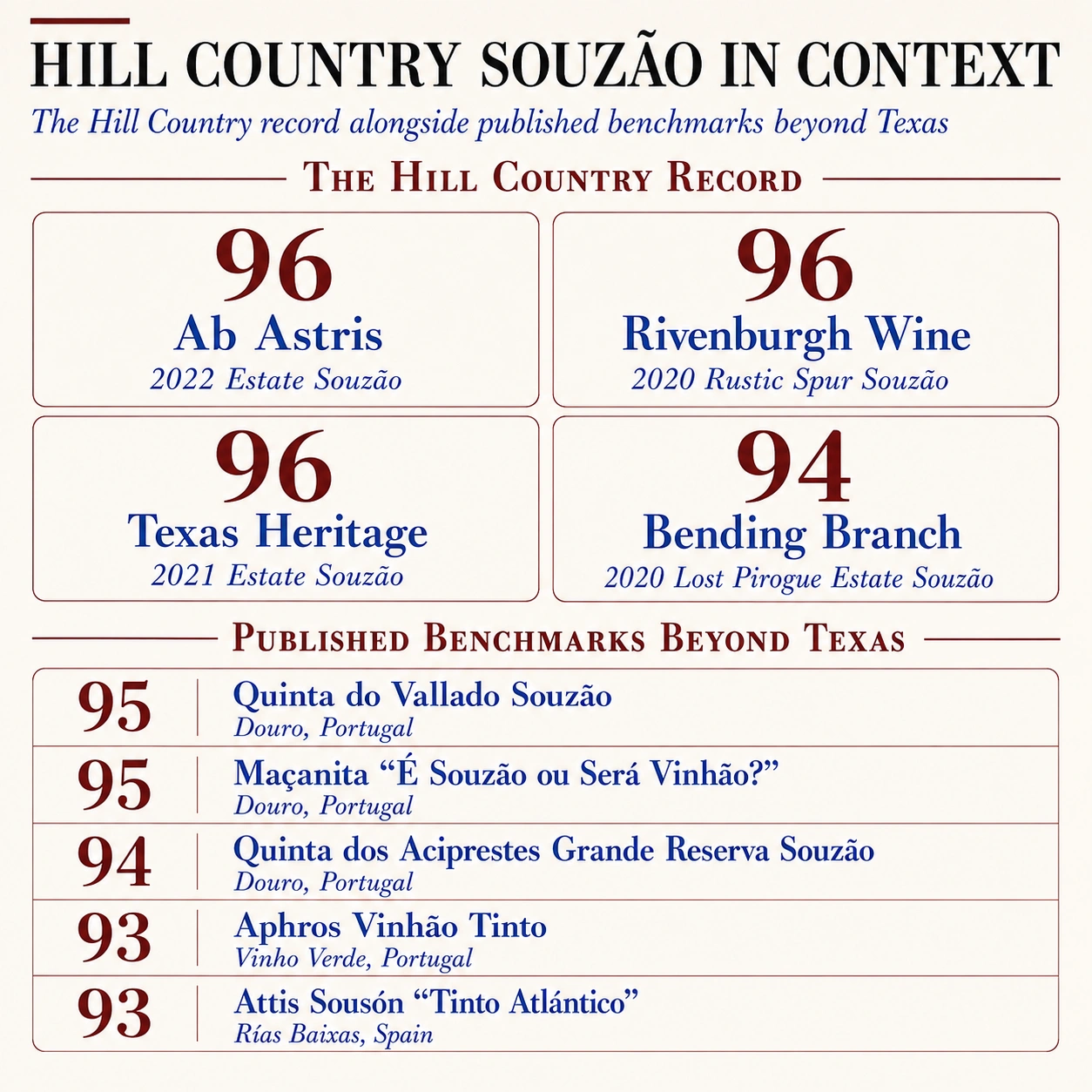
Jonathan Cristaldi awarded 96 points to both Rivenburgh Wine and Texas Heritage, and 94 to Bending Branch. James Suckling gave Texas Heritage 94 points and awarded 92-point ratings to Ab Astris and Bending Branch across multiple vintages.
Among the major critic and competition records reviewed for this article, the highest non-Texas varietal Souzão scores we found were 95 points. In Portugal’s Douro, both Quinta do Vallado Sousão and Maçanita “É Sousão ou Será Vinhão?” have received 95 points from Robert Parker’s Wine Advocate, while Quinta dos Aciprestes Grande Reserva Sousão received 94 points from Wine Enthusiast.
The Decanter competition adds another layer.
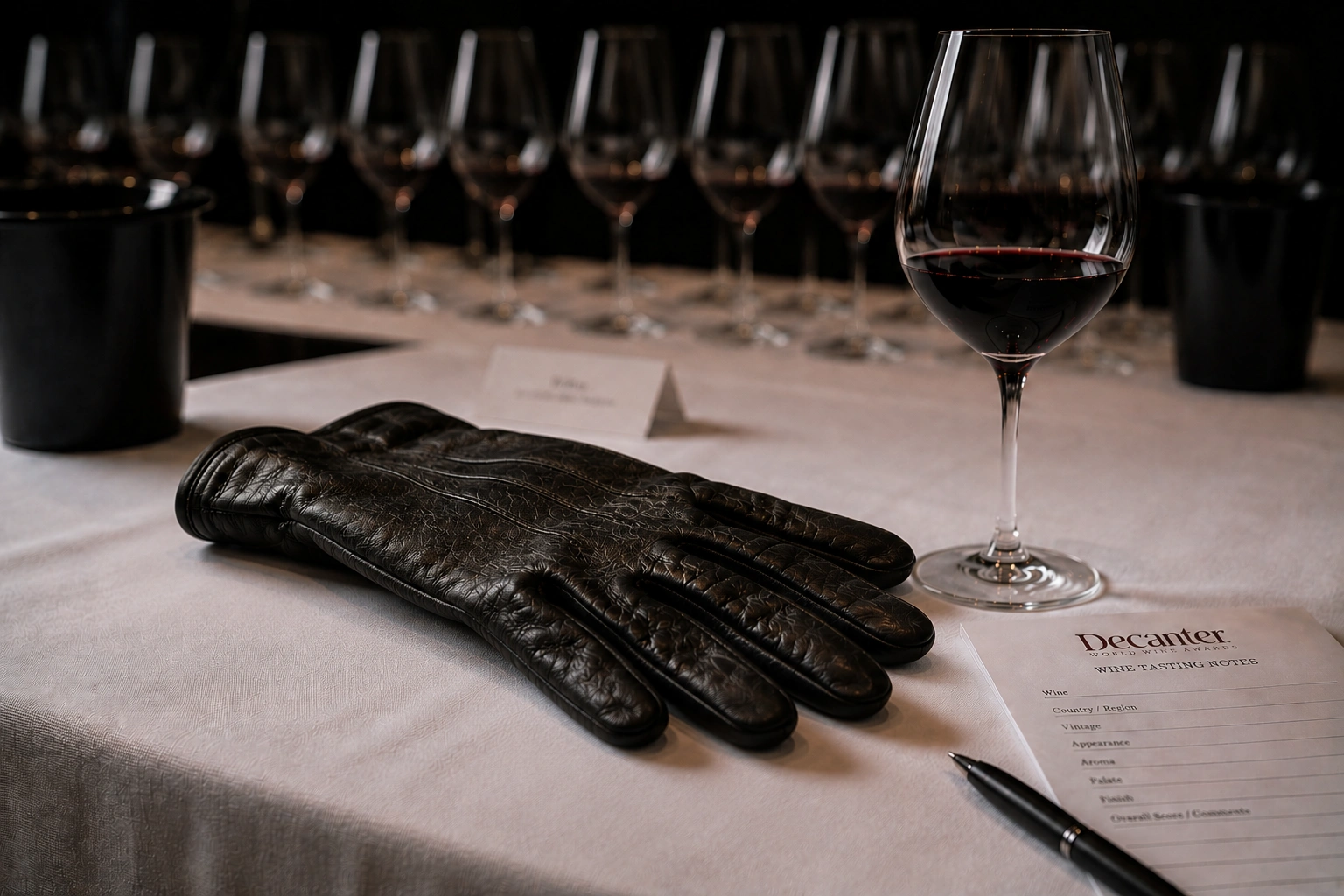
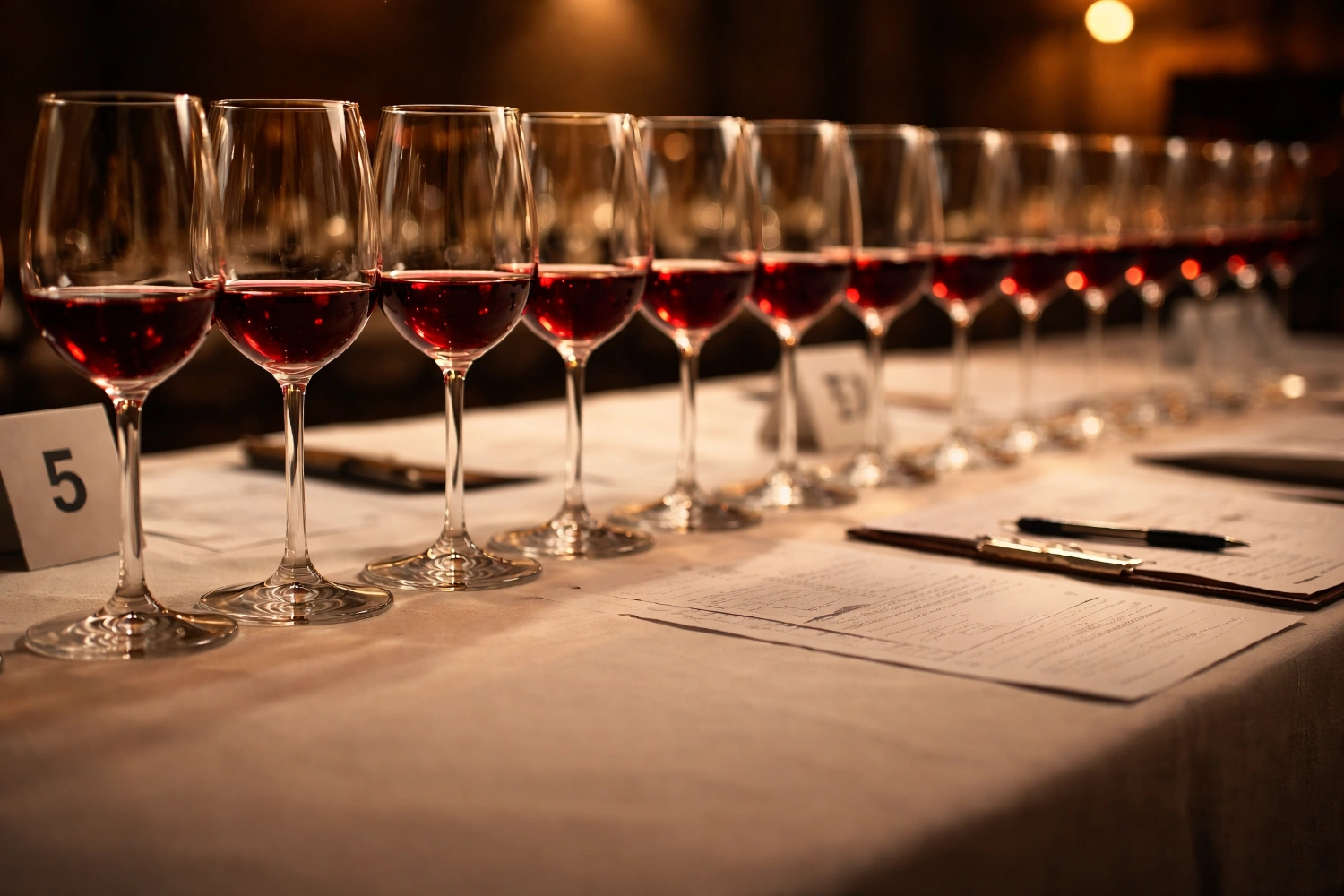
The 2026 Decanter World Wine Awards evaluated nearly 17,000 wines through blind tasting by 245 international experts, including Masters of Wine and Master Sommeliers. Wines were assessed by panels of specialists, discussed collectively, and any Gold medal had to be retasted and confirmed by senior judges. Gold medals accounted for only 5.56 percent of all entries.
The Ab Astris Souzão emerged from that process with 96 points and Gold, after being blind-tasted, debated and retasted through multiple stages of judging at the world’s largest wine competition.
But this is not the story of one extraordinary bottle—or one extraordinary moment.
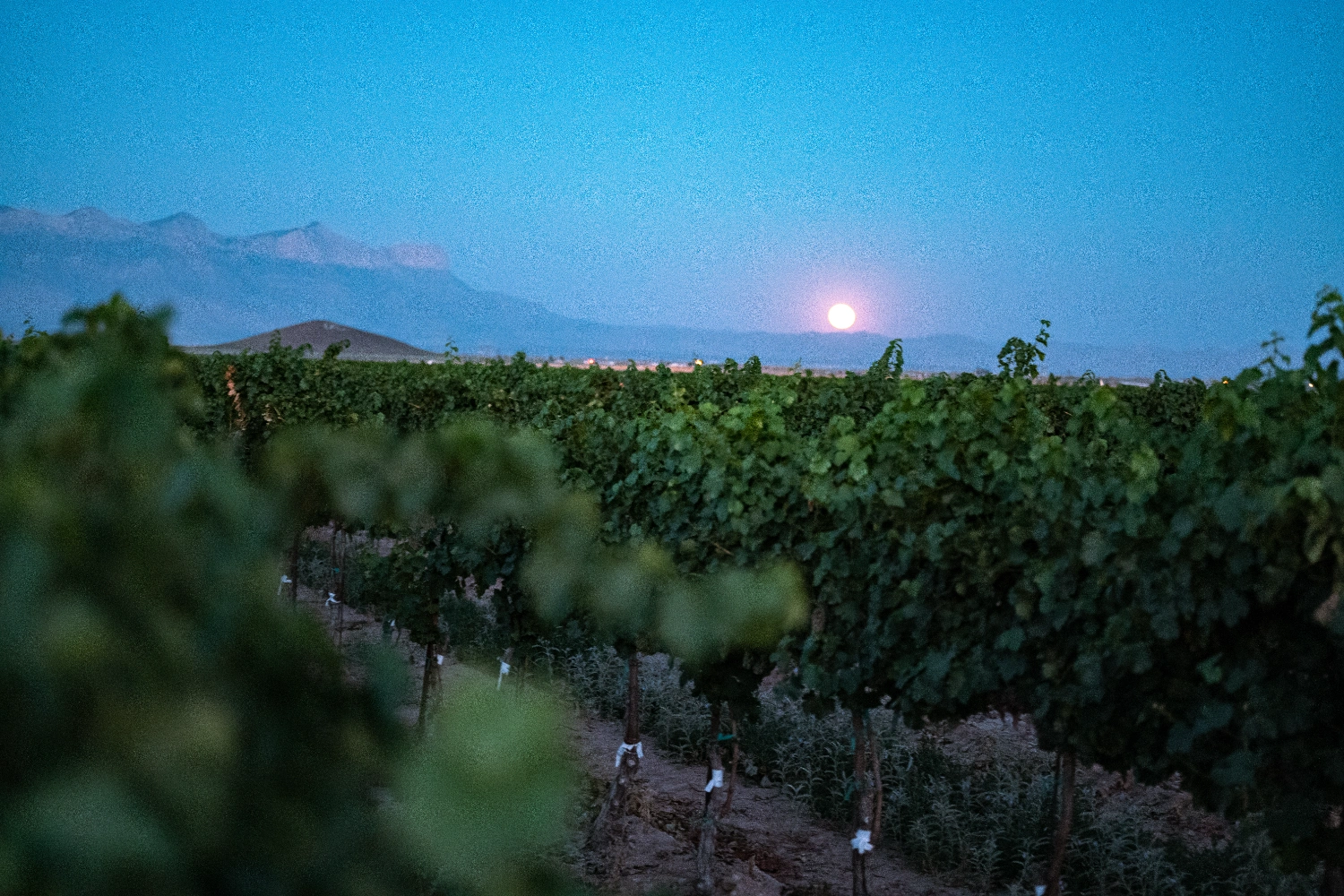
It is the story of a region discovering that a grape overlooked almost everywhere else has found in the Texas Hill Country a place where it excels.
In 2017, Elin McCoy hoped Texas wineries would take note.
They did.
And now the world has.
Featured Photo: Robbyn Dodd, courtesy of Texas Heritage Vineyard.
A note on ratings: The comparison includes varietal wines labeled Souzão and its principal synonyms, including Sousão, Vinhão and Sousón, and is limited to major critic records and Decanter World Wine Awards results available for review. Wines without published or accessible results necessarily fall outside the comparison.