I was on a flight to Europe, looking for a way to pass the time. I had downloaded a few things from Netflix, but nothing felt particularly compelling. So I turned to the in-flight entertainment and landed on James Suckling’s masterclass.
I had seen it before—my son-in-law had introduced me to it months earlier—but this time was different. I didn’t realize it then, but I was at the front edge of what I now think of as my wine awakening. I watched every episode. Then, on the return flight, I watched them again.
Bring up James Suckling’s name, and you’ll get a range of reactions. Some follow him closely. Others dismiss him with a familiar refrain: “You have to subtract five points from his scores.” And like any critic, you’ll find moments where his ratings diverge sharply from others.
But whatever your view, one thing is undeniable: the global scope of his work—and the influence that follows it.
A Bold Prediction
Not long after, I was walking through my neighborhood listening to Shelly Wilfong’s This Is Texas Wine podcast, which aired in February 2023 following the Texas Hill Country Wine Symposium that January. In that interview, she spoke with Jean Hoefliger.
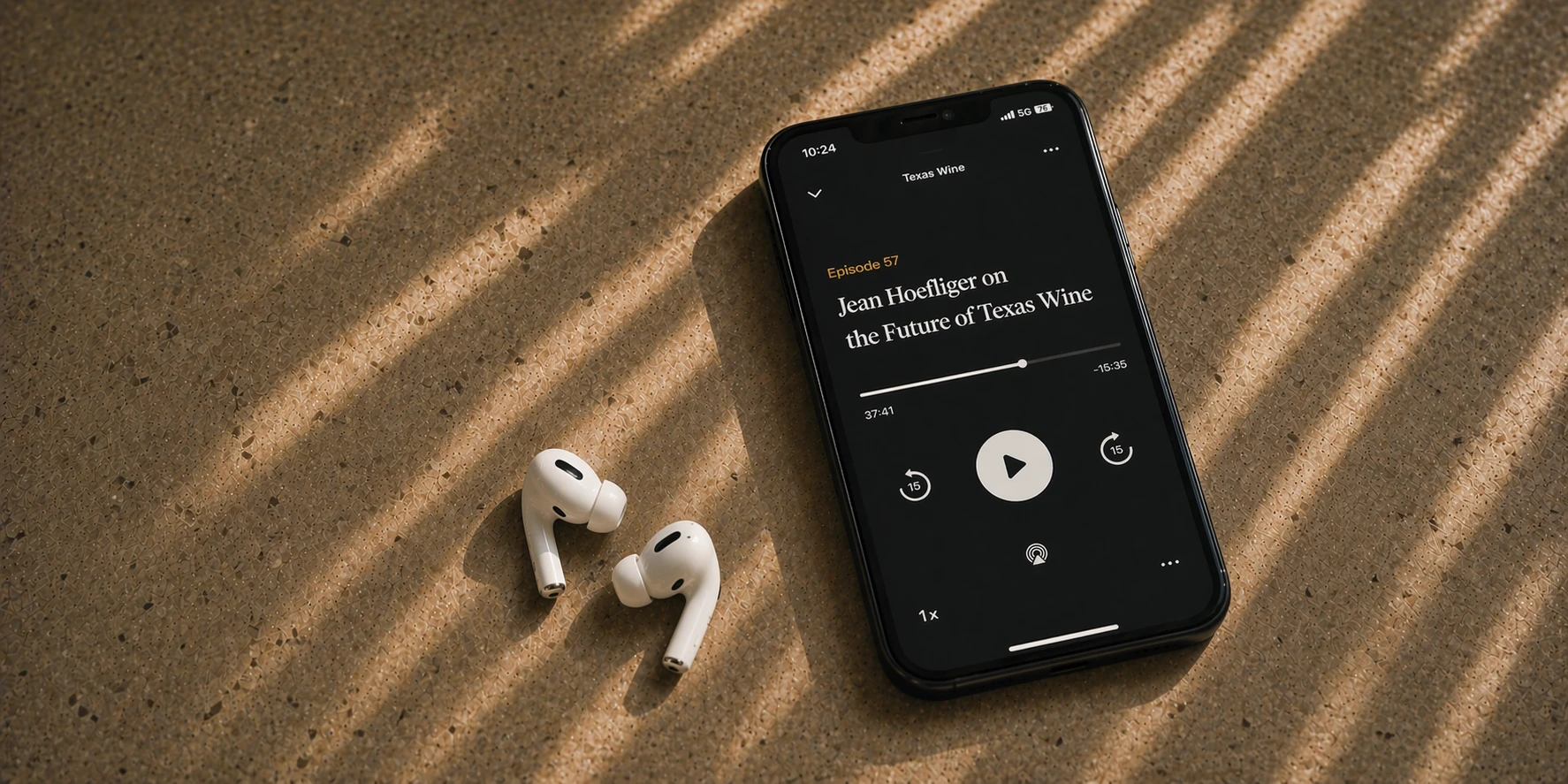
Hoefliger is not a casual observer. A Swiss-born winemaker with roots at Château Lynch-Bages, one of Bordeaux’s classified growth estates, experience in South Africa, and more than 15 years shaping Alpha Omega in Napa Valley, he brings a global perspective—one that now, increasingly, includes Texas.
At one point, Wilfong asked a question that carried real weight at the time—one that reflected a broader frustration within the Texas wine community.
“So the state of Texas is still reeling just a bit, because Wine Enthusiast doesn’t want to review our wines anymore… What does a state—how should we respond?”
At the time, Texas sat largely outside the regular coverage of most major wine critics.
You could hear it in her voice—the mix of disappointment and uncertainty. As a listener, I felt it too.
Hoefliger’s answer didn’t dwell there.
He pointed forward.
He mentioned that he had recently spoken with James Suckling.
Suckling, he said, was willing to come to Texas.
And then he made a prediction—one that, at the time, felt almost too clean, too certain:
“Already today, in Texas, you have a certain amount of wine that will rate between 90 to 96, 97 points… As soon as these ratings will come out, the rest of the press will come.”
It wasn’t just optimistic.
It was specific.
What Was Standing in the Way
For years, there had been a structural obstacle limiting how Texas wines were presented—and, in turn, how seriously they were taken.
The issue centered on labeling transparency.
Texas House Bill 1957—often referenced as the catalyst for modern “truth in labeling” in Texas wine—clarified how wines could represent their origin. It strengthened the connection between what was on the label and what was actually in the bottle.
For critics evaluating wines from outside the state, that matters.
Serious review depends on trust—that a wine labeled from a place is meaningfully of that place.
With that clarity in place, one of the key barriers to broader critical engagement was effectively removed.
Then It Happened
In November 2024, James Suckling’s team came to Texas.
On the first visit, Jim Gordon came on his own, focusing on the Texas Hill Country. On the second—less than a year later—he returned, this time joined by Brian Friedman, with the visit again centered in the Hill Country but also extending to the High Plains, where much of the state’s grape growing actually occurs.
There was real excitement around both visits.
But it didn’t take long for that excitement to be tempered by something else: questions about who was included—and who wasn’t.
The Way of the World — in Wine
This is where context matters.
When critics enter a region for the first time, they are not conducting a census. They don’t map every producer, knock on every door, or taste every wine.
They can’t.
Instead, they rely on a mix of relationships, logistics, and curation. Regional organizations, trade groups, PR networks, and local advocates all play a role in shaping what those visits look like.
It’s not unique to Texas. It’s structural.
Even Robert Parker—called the father of modern wine criticism—did not fully capture Burgundy in his early coverage. Some established producers, particularly those working in more restrained, traditional styles, were underrepresented or overlooked.
Over time, that picture tends to fill in.
In Texas, as it turns out, there were fewer exclusions than initially thought. Some producers thought to have been left out had in fact participated in the tastings. Others, in at least a few cases, had simply chosen not to take part.
Silouan Bradford of Saint Tryphon Farm & Vineyard—who declined to participate—offered a measured perspective on the significance of the visit:
“Nonetheless, I see it as exciting that Texas is attracting more and more international attention and without a doubt, Mr. Suckling… is of a caliber which should make us all excited.”
The Prophecy Fulfilled
Hoefliger didn’t just predict attention.
He predicted results.
“A certain amount of wine… will rate between 90 to 96, 97.”
Across the first two visits, by my count, 84 Texas wines received scores of 93 points or higher.
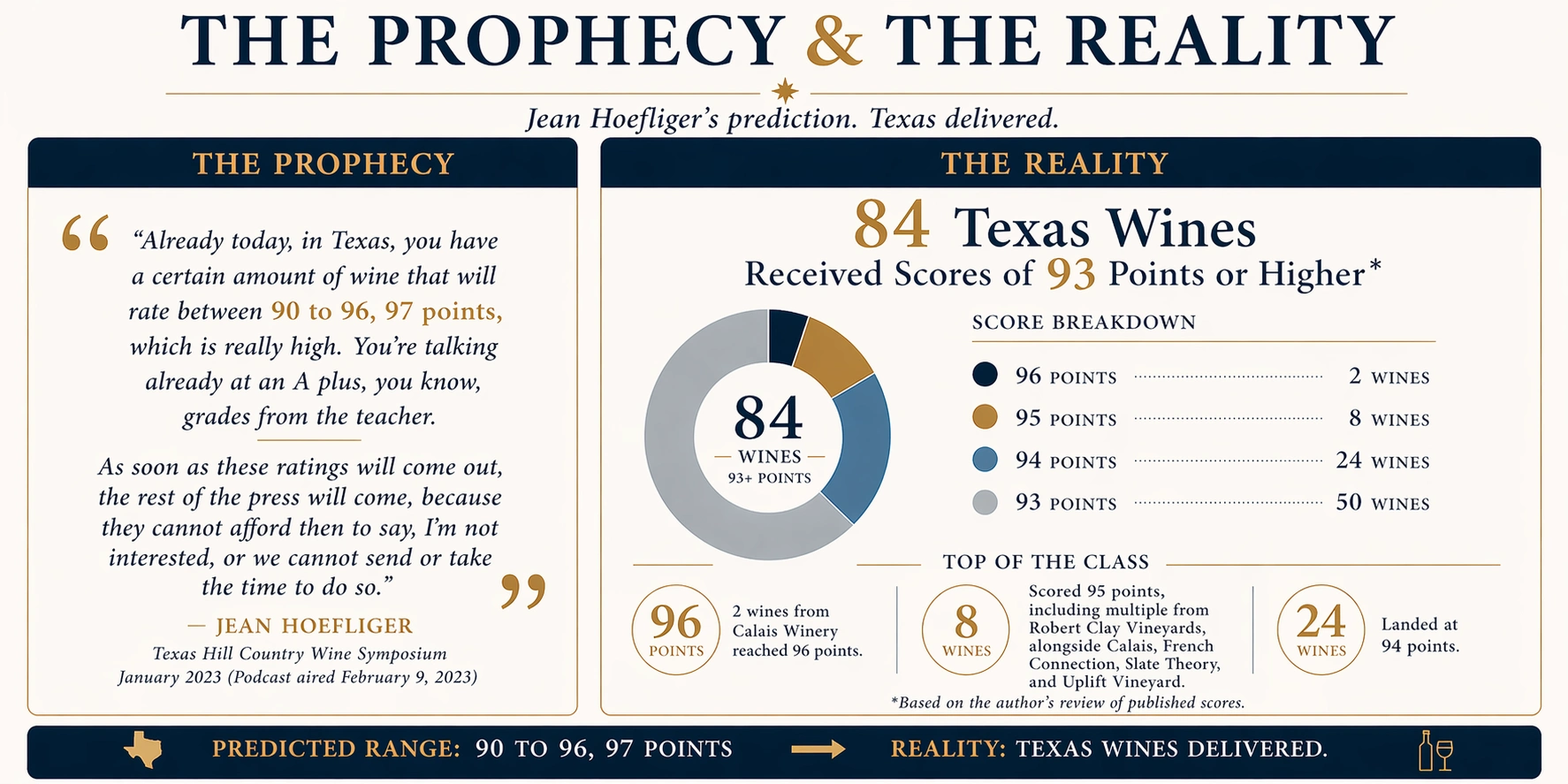
At the top, two wines from Calais Winery reached 96 points. Eight wines scored 95, including multiple from Robert Clay Vineyards, alongside Calais, French Connection, Slate Theory, and Uplift Vineyard.
Another 24 wines landed at 94 points—firmly in serious territory.
One of those Calais wines would go on to be named No. 38 in James Suckling’s Top 100 Wines of the United States—the first Texas wine ever to appear on that list—and the winery was subsequently invited to participate in his Great Wines of the World event.
The range Hoefliger predicted—90 to 96, even 97—wasn’t aspirational.
It was accurate.
“…the rest of the press will come.”
And then, the second part of the prediction began to unfold.
A few weeks ago, I saw Elisa Jones of Elisa Christopher Wines mention a Wine Enthusiast rating for one of her wines. It was a small moment—but a telling one.
Just a few years earlier, Shelly Wilfong had been asking what Texas should do in the absence of coverage.
Now, it was there.
Beyond that, independent critics like Jonathan Cristaldi have turned their attention to Texas. In 2025, Decanter published a dedicated feature: “Discover why Texas wine is poised for prime time.”
Even broader educational platforms have stepped in. The Wine Folly guide to the Texas Hill Country—driven by the sustained and deliberate efforts of Texas Hill Country Wineries—helped frame the region for a wider audience.
These weren’t isolated developments.
They were exactly what Hoefliger described.
Just As Predicted
The attention didn’t arrive all at once.
And it didn’t come from a single source.
But it came.
First, credible scores—right in the range he outlined.
Then, broader coverage—press that could no longer afford to ignore what was happening.
Not because someone declared Texas important.
Because the wines made it impossible not to.
Jean Hoefliger didn’t just make a bold prediction.
He described, almost step by step, how it would unfold.
And then it did.
Just like he said.
_____________________
Update: Since this article was published, Texas wines have also made a historic showing at the Decanter World Wine Awards, further underscoring the state’s growing presence on the international stage.