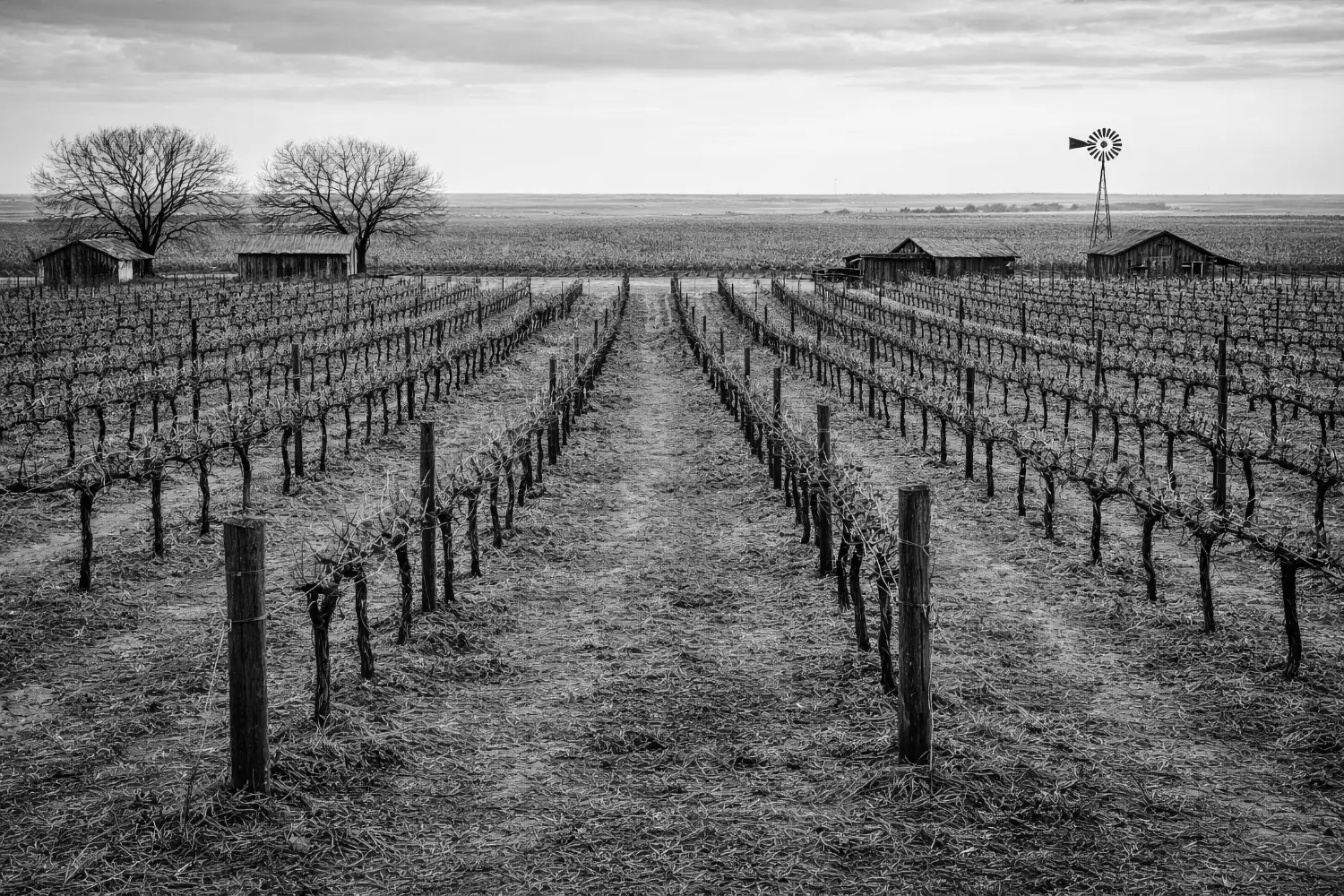
This work has been going on for centuries.
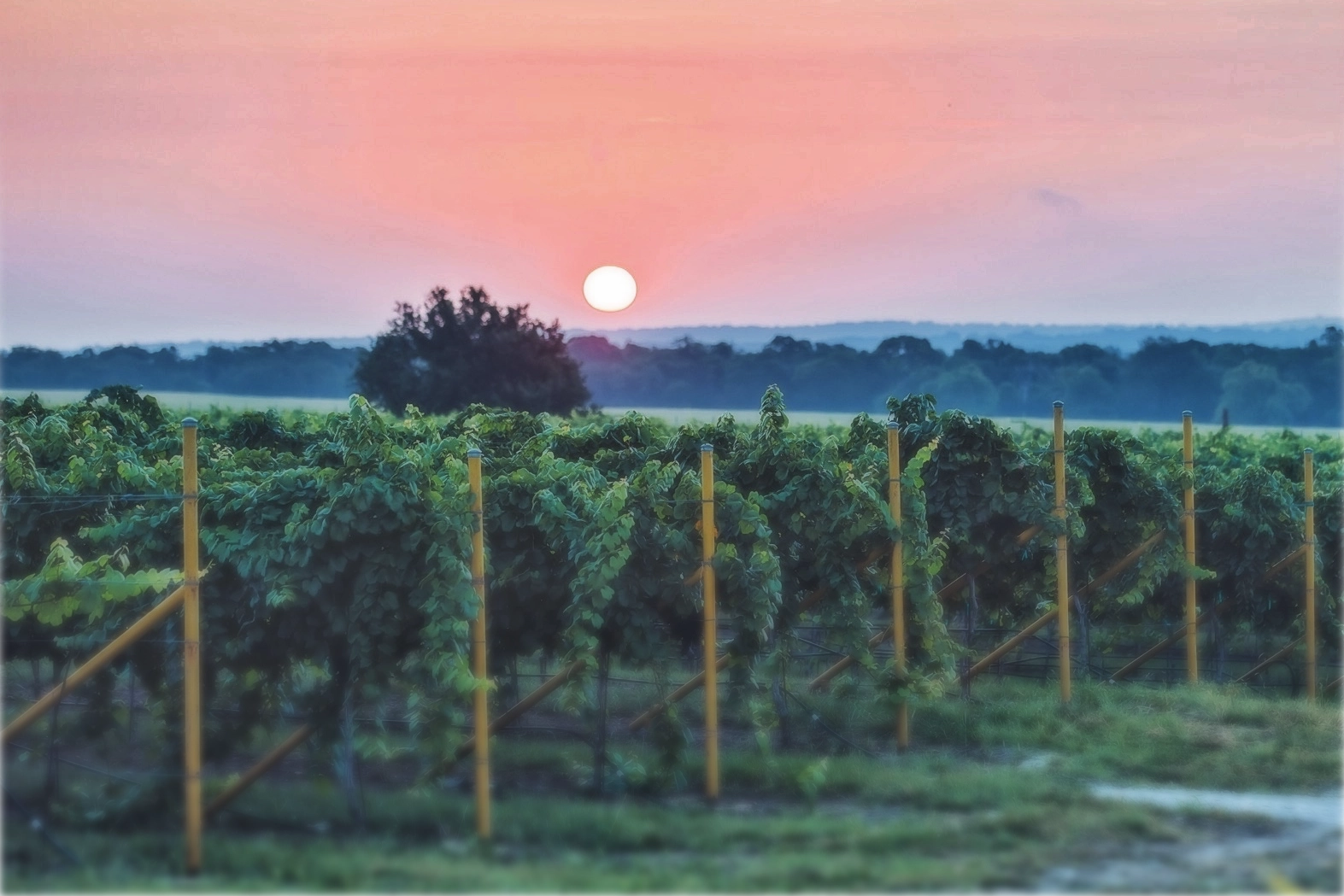
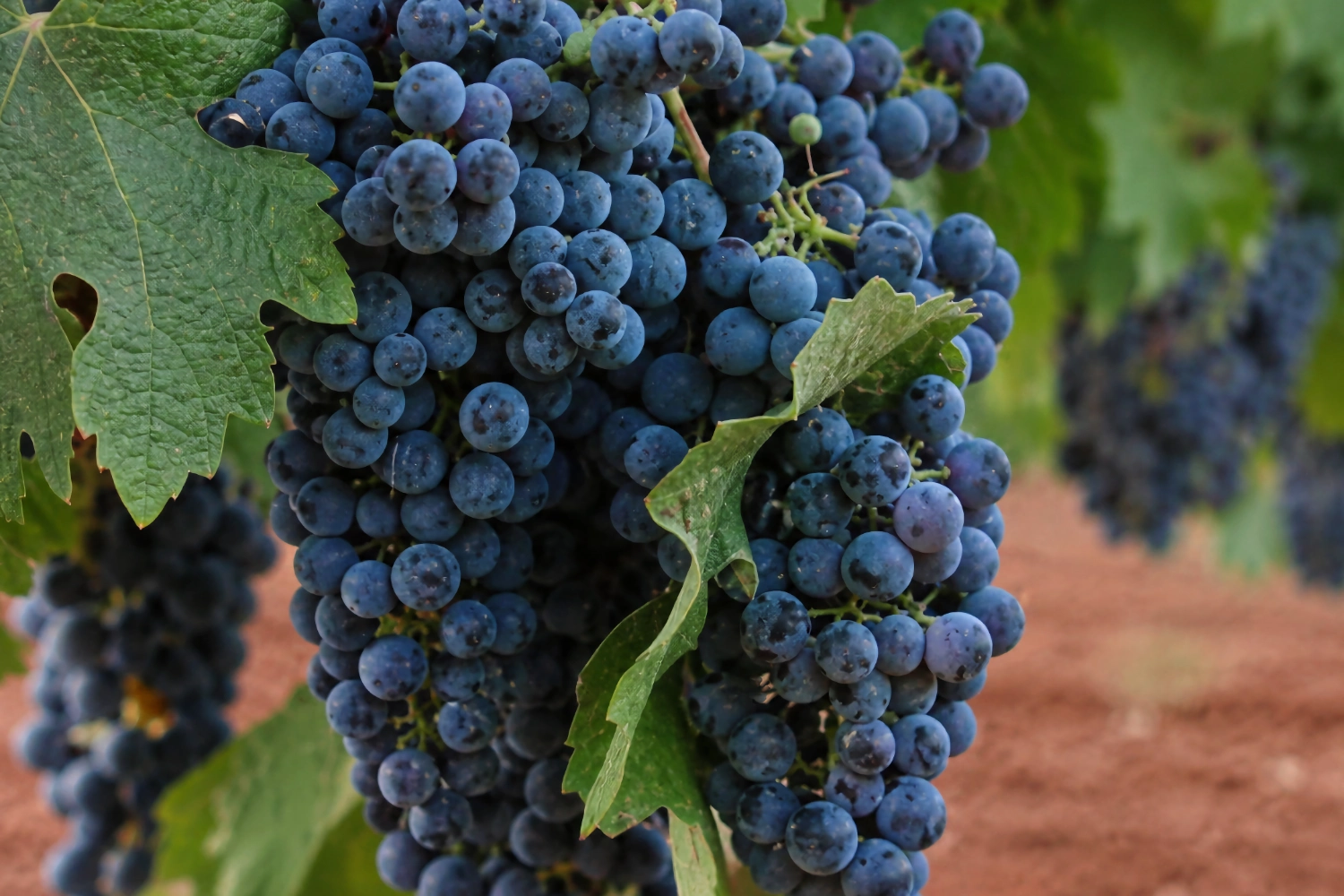
Walk through a vineyard at sunrise or into a working cellar during harvest, and winemaking still feels deeply ancient. Fruit is sampled berry by berry. Fermentations are watched closely, sometimes anxiously, as growers and winemakers try to guide an agricultural product toward something expressive, balanced, and alive.
That is part of wine’s enduring pull. It comes from the earth, but not easily. It is shaped by weather, soil, sunlight, human judgment, and time. At its best, wine can feel impossibly complete — color, aroma, texture, acidity, tannin, and place somehow coming together in a single glass.
But that completeness is never accidental.
Every wine region has its own negotiations to make. Burgundy has frost. Bordeaux has rain. Champagne has long fought for ripeness in a marginal climate, even as warming conditions now bring new questions. California has drought, fire, and heat.
Texas has its own set of pressures: abundant sunlight, high temperatures, wind, water limitations, and growing seasons that can move quickly from promise to urgency.
The task is not simply to grow grapes in those conditions. It is to grow grapes capable of becoming compelling wine.
That distinction matters.
Because the story of modern Texas wine is not just a story of more vineyards, more wineries, or more attention from critics.
It is also a story of precision — of growers and winemakers learning how to work more deliberately with a place that rarely rewards guesswork.
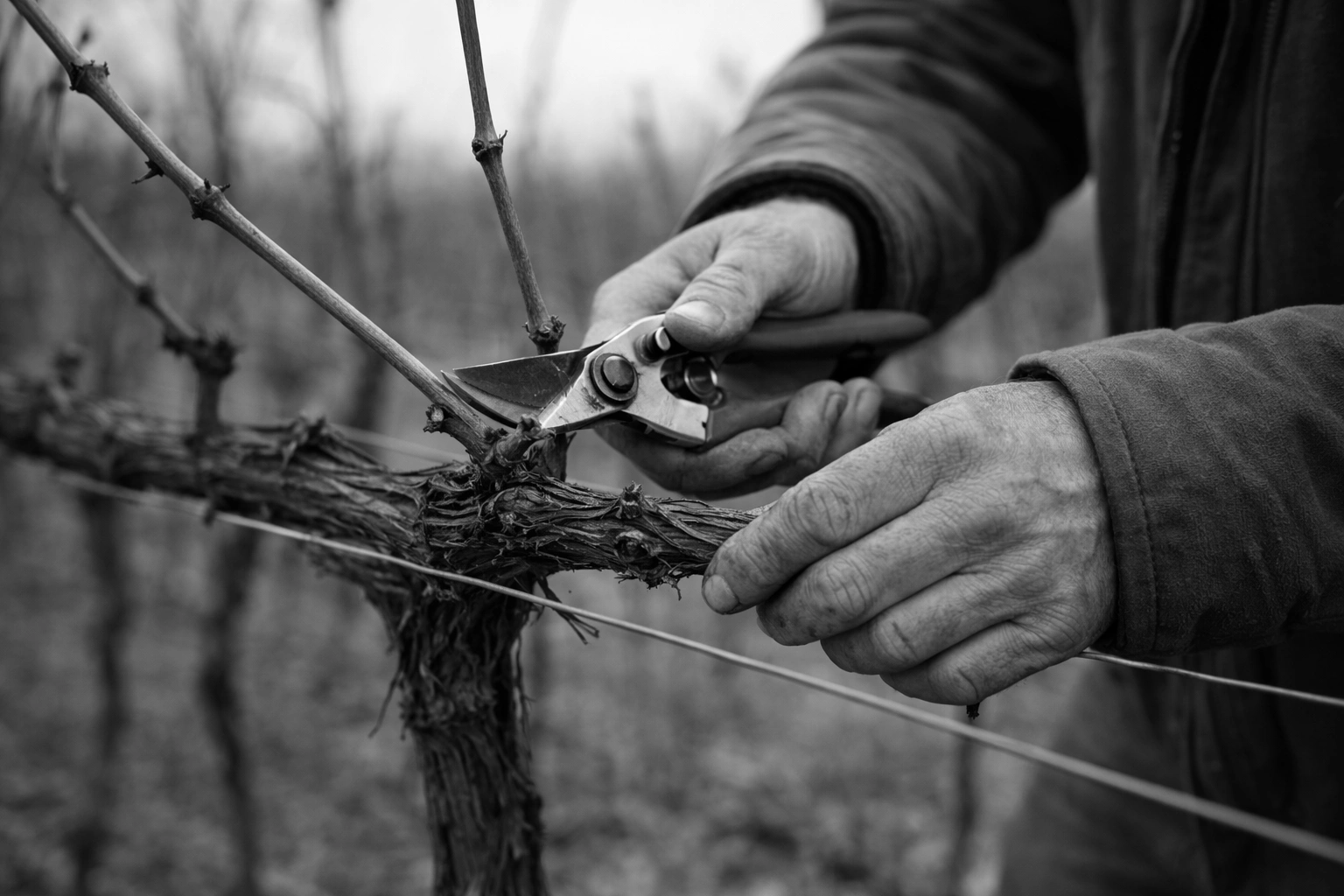
Some of that precision is old. It comes from walking rows, touching leaves, tasting berries, watching the sky, and knowing when to wait.
Some of it is new.
And some of the most interesting Texas wines are being shaped somewhere in the relationship between the two.
Under the Texas Sun

Beneath the Texas sun, balance becomes the grower’s real work.
Most wine drinkers have heard some version of the idea that vines need to struggle to produce great wine. That’s true. Too much water or nutrition can make a vine grow vigorously, but that growth does not translate into concentrated, expressive fruit.
But struggle is not the same as suffering.
A vine under thoughtful pressure may produce better fruit. A vine under too much stress can shut down, slowing or stopping the very development the grower is trying to encourage.
In a warm region, that balance becomes especially important. Sugar can accumulate quickly, while the slower development of tannins, color compounds, flavors, and aromatic complexity may need more time.
That is one of the central tensions in Texas winegrowing: not whether grapes can ripen, but how to help them ripen—completely.
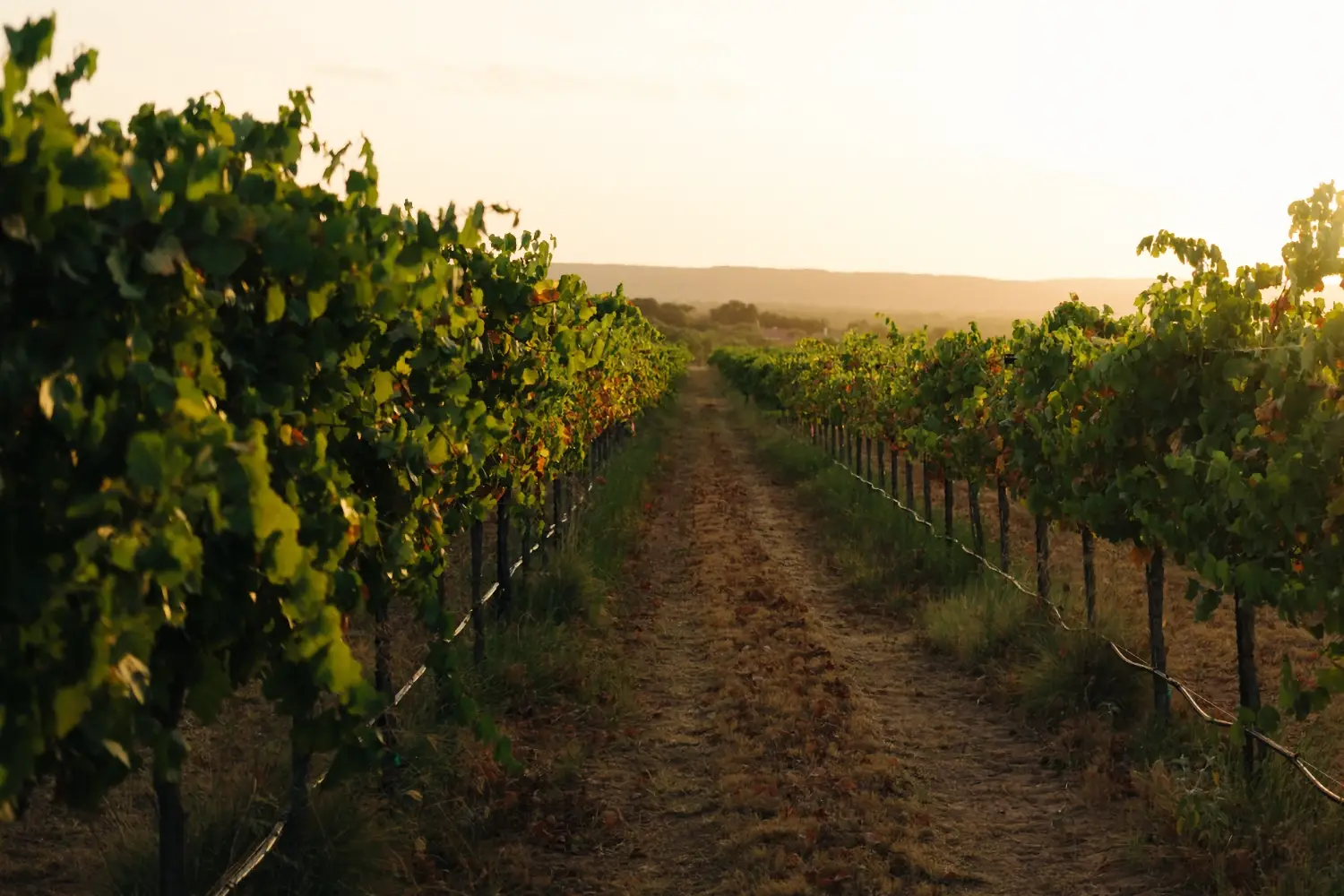
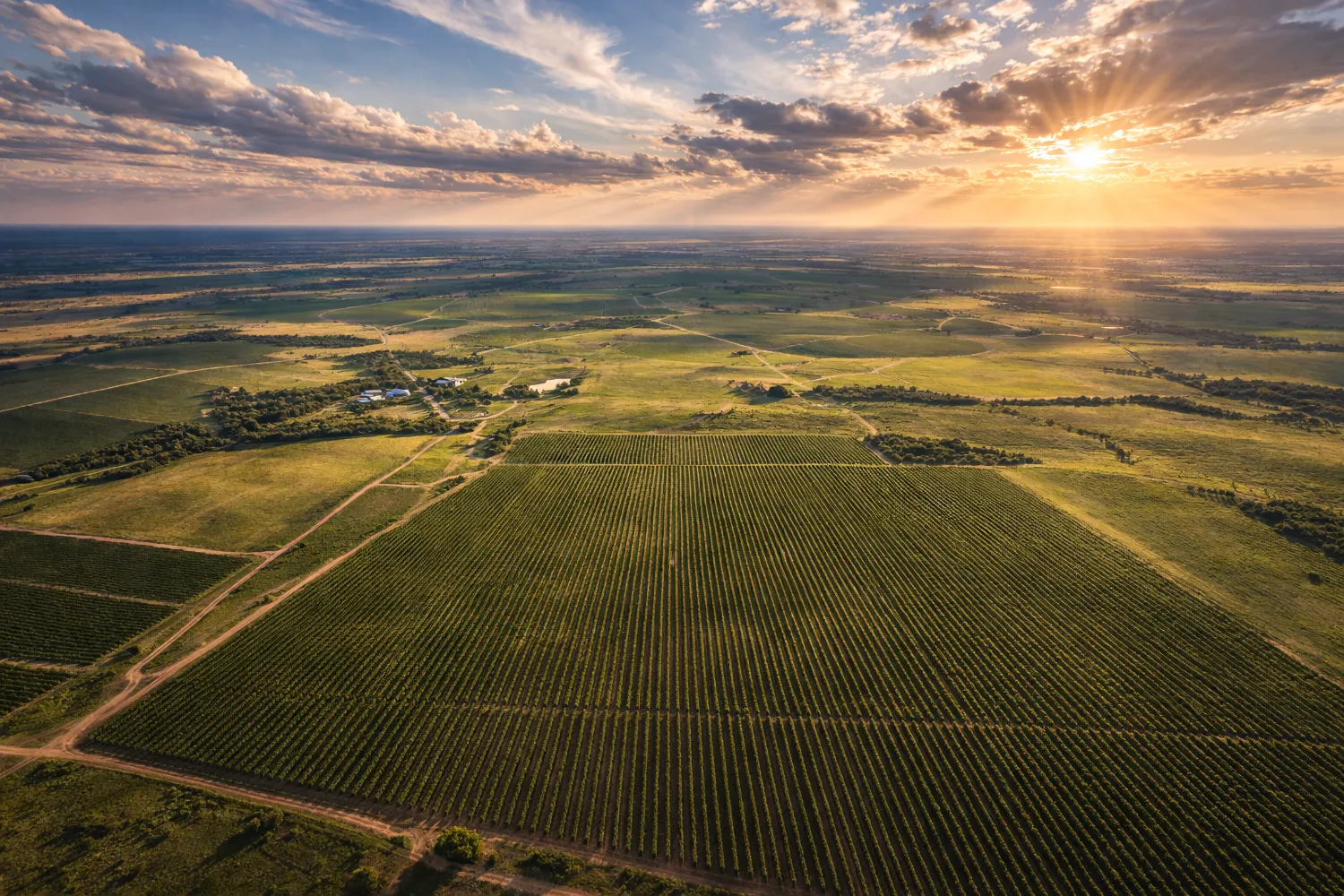
In the Texas High Plains, that question is often tied to water. The region’s elevation, sun, wind, and diurnal shifts give it important advantages, but they also make irrigation one of the grower’s most consequential decisions.
At Reddy Vineyards, one of the state’s leading High Plains growers, precision begins with long familiarity.
Akhil Reddy describes a farming philosophy shaped by decades of studying the site, its soils, and its microclimates. His father, Vijay Reddy, holds a PhD in soil and plant physiology, and that depth of experience has become the lens through which new tools are evaluated.
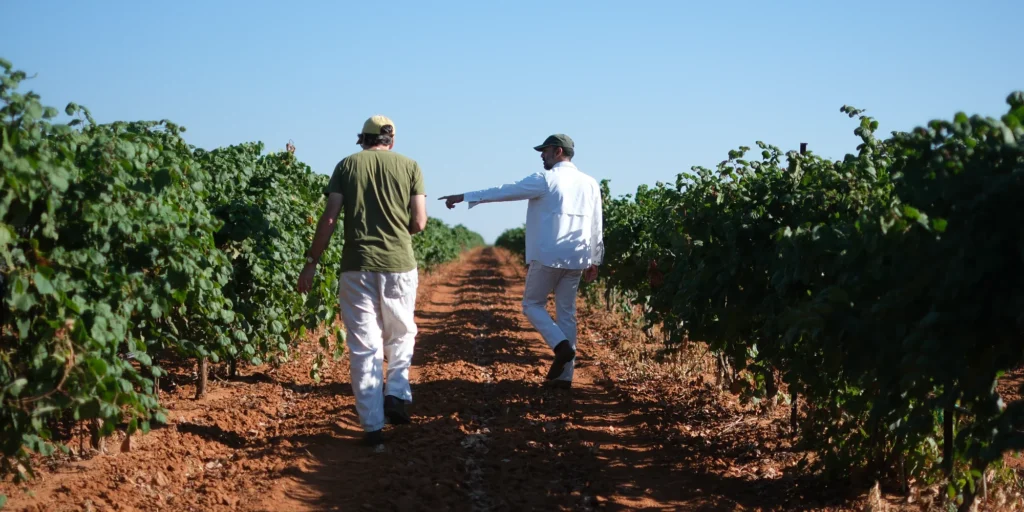
At Reddy Vineyards, precision begins with long familiarity: walking rows, studying soils, and understanding how vines respond under the Texas sun.
Reddy watches new technology closely, but adopts it deliberately. Every tool has to serve the fruit and the farm, not the other way around.
In the vineyard, that philosophy shows up most clearly in water management.
Reddy uses sub-surface drip irrigation as a central part of its farming, delivering water below the surface where roots can use it while reducing loss to evaporation. The vineyard also uses controlled deficit irrigation: the careful practice of giving vines slightly less water at specific points in the growing season to encourage concentration without pushing them into damaging stress.
More than 40 irrigation sets across the property allow the vineyard team to control flow rates and direct water where it is needed, guided by methods refined over decades.
The goal is not merely to keep vines alive in a dry climate. It is to keep them in balance long enough for fruit to move beyond sugar accumulation and develop color, flavor, tannin, and aromatics.
That kind of precision can show up in unexpected ways. Reddy grows Pinot Noir — still a rarity in Texas — and its fruit was used by Elisa Christopher Wines for a 2023 méthode traditionnelle Sparkling Pinot Noir that received 94 points from Jonathan Cristaldi and was named a winner in the 2025 Texas Vintners Cup. Reddy is best known as one of the state’s leading growers, but its own 2020 TNT Tempranillo also won Best of Class at the San Francisco Chronicle Wine Competition.
The vineyard is also mapped by variety, clone, and row, with detailed historical records on growing conditions, yields, and experiments across the site. Akhil calls that historical dataset one of the vineyard’s most valuable assets.
That may be the real lesson from Reddy’s approach: modern innovation works best when it is layered onto older forms of knowledge — the accumulated understanding of soil, vine, weather, and place.
Reddy continues to evaluate newer tools, including drone technology for heat mapping, canopy density, and moisture monitoring, along with other emerging forms of agricultural technology. But the approach is deliberately measured.
The vineyard has tested some tools, passed on others for now, and remains cautious about chasing every new release. For Reddy, innovation is not a race toward the newest device. It is a way of asking what will genuinely improve the fruit.
Increasingly, that also means looking back.
Akhil says the vineyard’s focus is shifting toward old-world farming practices: cover cropping, rotating animals onto the property, and building long-term sustainability into the farm itself.
In that sense, the future of precision viticulture at Reddy may not be purely digital. It may be the careful combination of data, discipline, soil knowledge, and older farming practices brought forward with new intention.
An Eye for Quality
If the vineyard determines the potential of a wine, the sorting table determines what enters the cellar.
Sorting fruit has long been one of the essential rituals of serious winemaking. Before fermentation begins, leaves, stems, damaged berries, underripe clusters, and other unwanted material are removed. It is exacting work, and important work, because everything that enters the tank has the potential to shape the finished wine.
The traditional sorting table depends on human attention. Hands move quickly. Eyes scan for what does not belong. Decisions are made in seconds.
But harvest has its own urgency. Fruit can arrive quickly. Workers get tired. Sorting crews vary in experience. And in warm regions, compressed picking windows can put additional pressure on everyone involved.
That pressure has made sorting one of the places where technology can change the outcome.
Optical sorting offers an answer.
Before the optical sorter ever makes a decision, the fruit has to be prepared for inspection. Grapes move across a vibrating table that spreads them into a single layer and allows loose debris, raisins, and other unwanted material to fall away. From there, the berries drop onto the sorter’s grooved blue belt, which aligns them as they accelerate beneath the camera.
Then the “eye” goes to work. A high-speed camera evaluates each berry against parameters set by the winemaker — color, size, and shape among them. Berries that fall outside those standards are expelled by precisely timed bursts of air into a rejection bin, while accepted fruit continues into a clean bin for fermentation.
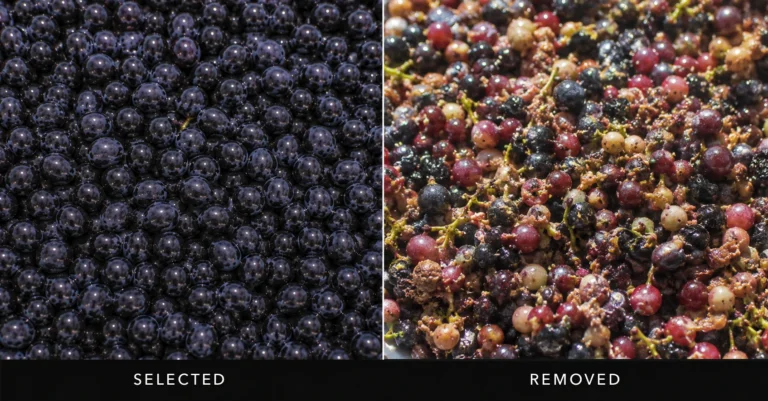
Kalasi Cellars was the first winery in Texas to invest in optical sorting, making the technology part of a broader quality philosophy: protect the purity of the fruit before fermentation begins.
The results do not belong to a machine alone, but they are hard to ignore: Kalasi has now released 15 consecutive wines scoring 90 points or higher, several of them at 93+. Among them is the 2022 Raj Collection, which received 95 points from Jonathan Cristaldi and 94 points from James Suckling.
For winemaker Nikhila Davis, the improvement shows up in wines that are smoother and richer, with fewer green characteristics and better-integrated tannins.
It is easy to make this sound futuristic. But the underlying idea is ancient and simple:
The best wine begins with the best fruit.
Optical sorting is not a substitute for taste, judgment, or intention. It does not decide what a wine should be. It simply gives the winemaker a more exacting way to protect purity at the moment when fruit becomes wine.
That is true in any region, but especially in places where ripening is uneven, harvest decisions are compressed, or a single lot of fruit contains berries at slightly different stages of maturity.
There is a philosophical question here, too. Some winemakers argue that a degree of variation can add complexity — that wine should not be polished into sameness. That is a fair caution. The goal is not sterility. Wine should still feel alive.
But there is a difference between complexity and compromise.
When optical sorting works well, its effect is not something a drinker should experience as technology. The reward is clarity: cleaner fruit expression, fewer green edges, more seamless texture, and a wine that feels more intentional from the first aroma to the last impression.
In that sense, the machine disappears.
What remains is the fruit.
The Art of Extraction: Color, Texture, and Structure
Once fruit enters the winery, the question changes.
The grower has done the work of getting grapes to harvest. The sorting line has protected the best material. Now the winemaker has to decide how to transform that fruit into wine — how much to draw from the skins, seeds, and pulp, and how to do it without losing balance.
This is one of the most delicate parts of red winemaking. Too little extraction, and a wine may feel pale, thin, or unfinished. Too much, and it may become coarse, bitter, or heavy.
Bending Branch Winery has become one of Texas’s clearest examples of using cellar technology to work inside that balance.
Under Dr. Bob Young, Bending Branch has explored techniques such as cryo maceration and flash détente not as universal formulas — but as selective tools. That difference matters.
The goal is not to impose technology on every wine. It is to choose the right method for the fruit, the vintage, and the style being pursued.
Cryo maceration is a more intense version of a familiar pre-fermentation idea: using cold to draw color and aroma from fruit before alcohol begins extracting more aggressively. Instead of merely chilling the grapes, cryo maceration freezes them, rupturing cells in the grape skins and opening the fruit in a way that allows deeper extraction of color and aromatic compounds than a gentler cold soak alone. Because this happens before fermentation fully begins, it can help build depth and fragrance while limiting harsher tannin pickup early in the process.
Flash détente, developed in France and now used by wineries in multiple regions, takes a more dramatic path. Grapes are heated to roughly 185 degrees, then moved into a vacuum chamber, where the sudden pressure drop causes the temperature to collapse by more than 100 degrees in seconds. That rapid shift ruptures cell structures, releasing color, flavor, and tannin compounds more quickly and thoroughly than gentler heat-based methods.
The difference shows up in the wine. Traditional thermovinification can be effective at extracting color, but it does not always build the tannin backbone needed for longer aging. Flash détente was developed, in part, to go further — drawing out deeper color while also helping build the texture and structure that make a red wine feel complete.
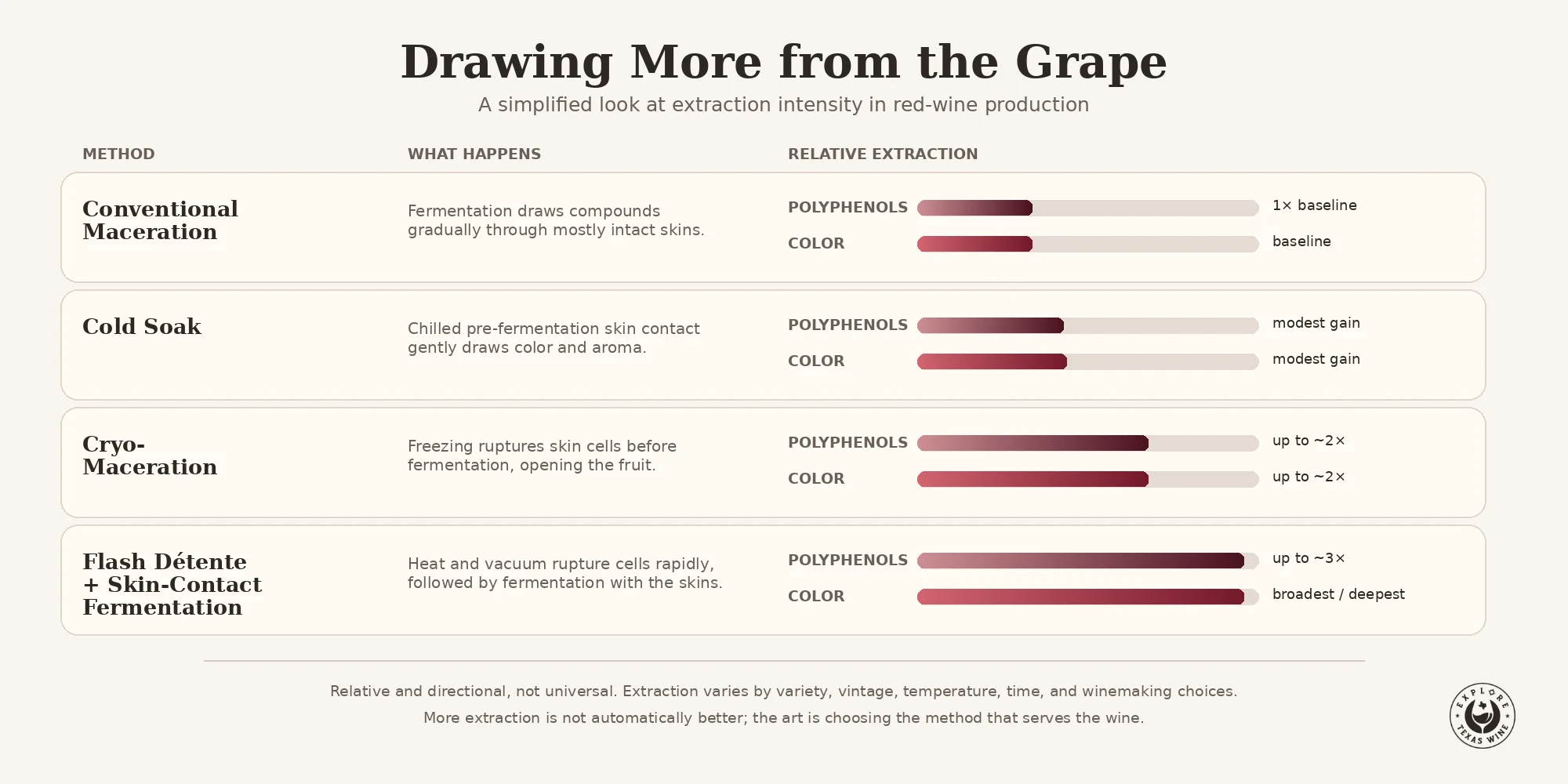
Some winemakers and wine lovers will always prefer a lighter touch, believing vineyard and vintage speak most clearly with fewer interventions. Others are more open to modern tools. But the underlying question is the same: what best serves the wine?
The process may be modern, but the ambition is familiar: to draw more from the fruit without losing balance. The question is whether the resulting wine has more depth, better color, more integrated tannins, and a fuller sense of expression than it otherwise might have had.
Bending Branch’s interest in these techniques also connects to Dr. Young’s long-standing focus on polyphenols, procyanidins, and thick-skinned varieties such as Tannat. With his background in preventive medicine, Young has often looked closely at the compounds that give certain red wines their color, structure, and grip — what he sometimes calls “the good stuff” — as well as the long history of interest in red wine’s possible benefits. He is careful not to reduce wine to a health claim, but the connection helps explain why extraction, for him, is about more than intensity. It is about drawing out the depth, texture, and dimension already held in the fruit.
Used thoughtfully, extraction technology can help a wine feel more complete.
That does not mean bigger for the sake of bigger. It does not mean darker for the sake of darker. The best use of these tools is not about force. It is about integration — drawing more from the fruit while keeping the wine balanced, expressive, and pleasurable.
Bending Branch’s 2021 Texas Cowboy Cuvée Reserve offers one example of that approach in practice. Made with cryo maceration followed by flash détente, the wine went on to earn Double Gold at the San Francisco Chronicle Wine Competition. But the medal is not the real point. It is evidence of something larger: a winery using both scientific curiosity and sensory ambition to ask how Texas wine can become more compelling.
The Ancient Work Remains
There is a danger in writing about wine technology. The tools can become the story.
But wine is not compelling because a vineyard uses sensors, or because a winery has an optical sorter, or because a cellar contains advanced extraction equipment. Those things are only interesting if they lead somewhere more human and more sensory.
To the color in the glass.
To the freshness that survives a hot growing season.
To tannins that feel polished rather than harsh.
To fruit that tastes clear rather than muddled.
To wines that carry both ripeness and energy.
To a sense that Texas wine is not merely improving, but becoming more articulate about itself.
That may be the real significance of these technologies. They are not replacing the old craft. They are helping refine it.
The ancient work remains: growing, choosing, tasting, waiting, deciding. The vineyard still has to be walked. The fruit still has to be understood.
And now, more tools for the work.
Something old. Something new.
All for the same purpose: something beautiful in the glass.